
Hospital Cubicle Curtain
The cubicle curtain procurement actually approved.
FR antimicrobial fabric to BS 5867 Part 2 Type C and ISO 20743 at 99.9 percent through 50+ wash cycles. Manufactured in Puncak Alam under ISO 9001. Delivered to 21 hospitals across Malaysia and Singapore since 2008.
Hospital cubicle curtains look small on the BOQ. They look bigger at the audit.
That happens when the substituted fabric fails BS 5867 Type C. Or when the cert pack arrives late. Or when the change-cycle log shows variance at the MSQH visit.
You skip all three when the cert pack ships with the order, the four-cert stack is filed before delivery, and the 21-hospital project record is yours to cite.
Below: the spec, the change-cycle math, the project list, and the components your team prices from.


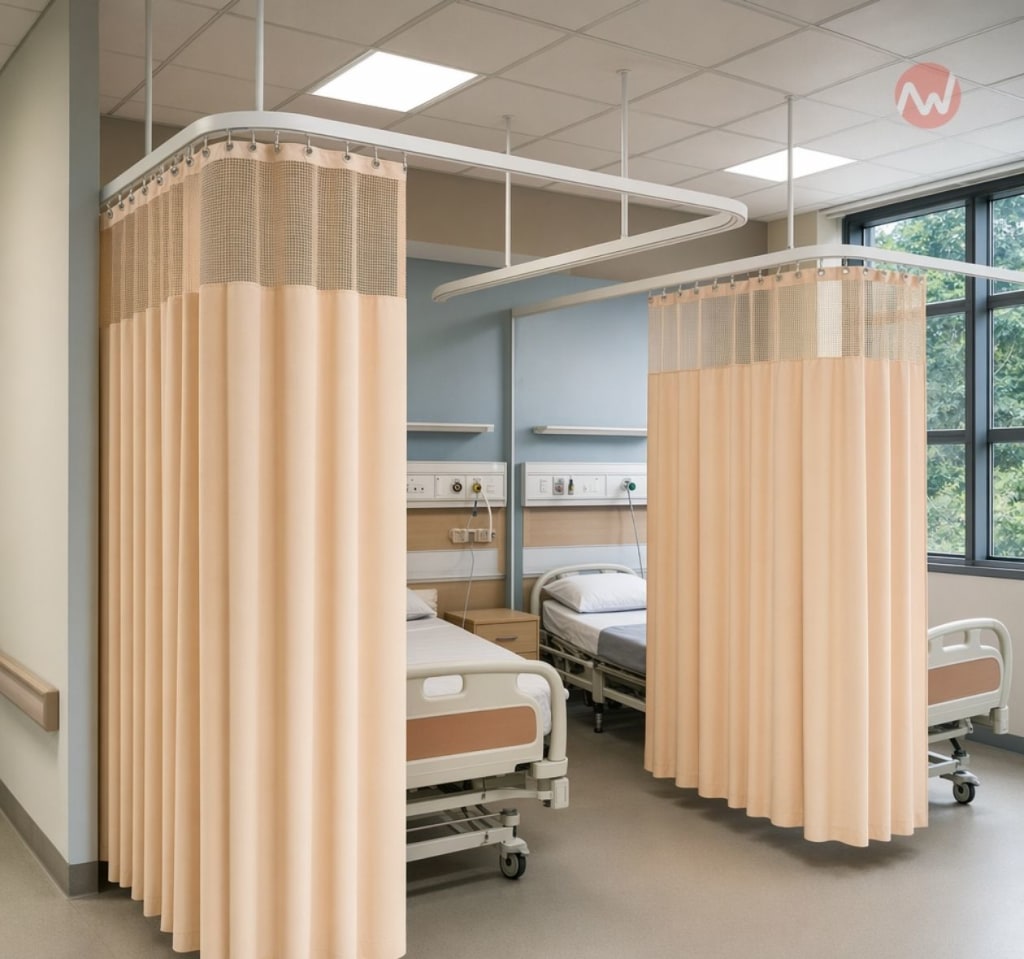
Drawn shut, this curtain seals the bay while the mesh top keeps air moving. 
Fully hung ahead of the room's finishing work, ready for daily use. 
One consistent cream tone unifies every bay along this ward run. 
A curtained corner lets the desk share the room without losing patient privacy. The curtain closes the exam corner while the sink area stays open for staff. 
Enclosed on every side, this bay gives full privacy right beside the corridor. Bays line up on both sides, each closing off fully for the patient inside. 
Full coverage on both bays, drawn closed in one motion. 
The bay closes fully around the exam bed, ready before the room's fit-out wraps up. Fully closed, this curtain gives the exam corner complete privacy from the room beyond. 
One fabric, ready in the colors a ward needs, packed and labeled for quick installation.


Trusted, Loved And Installed By


Three configurations cover most cubicle bays.
Every ward floor mixes three bay types: general, ICU and isolation, mental-health or at-risk. Each one needs a different curtain. We make three configurations to match what MY and SG hospital wards actually specify. Pick the right one at design stage. Your BOQ writes itself.
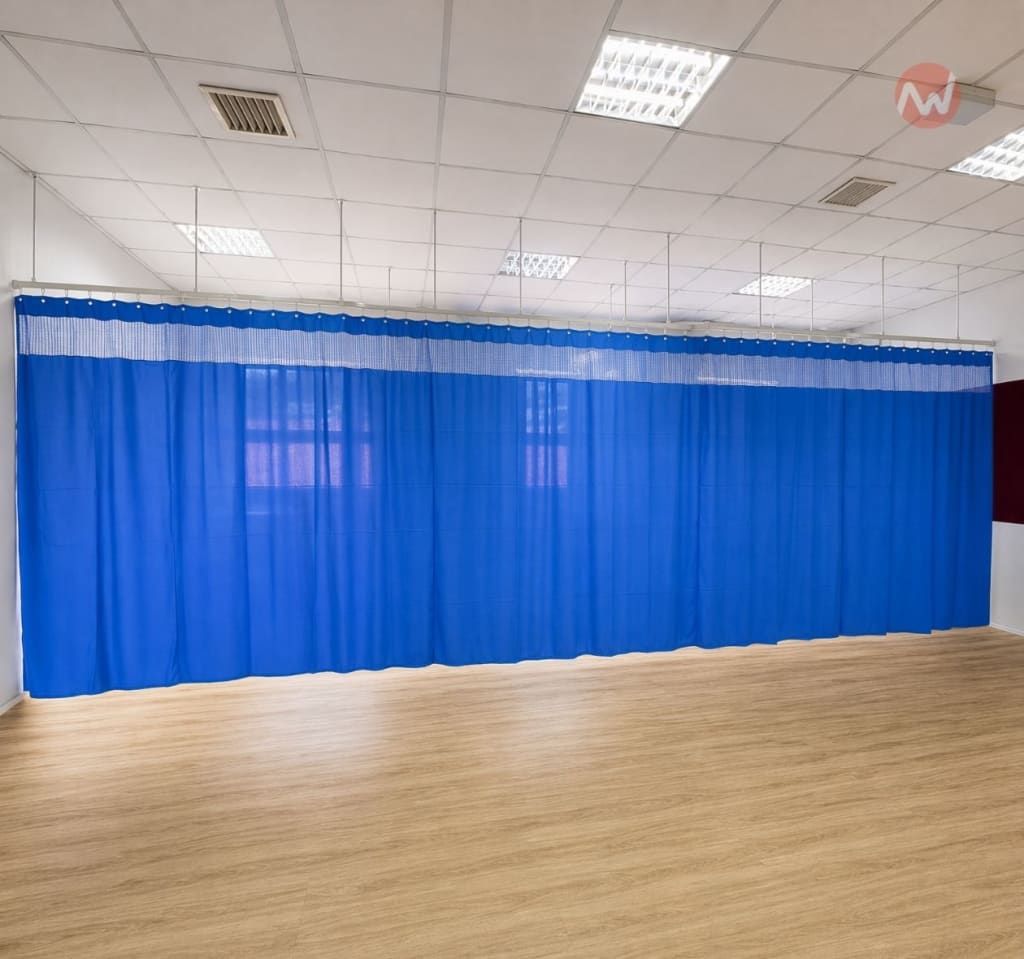
Three configurations cover most cubicle bays.
Every ward floor mixes three bay types: general, ICU and isolation, mental-health or at-risk. Each one needs a different curtain. We make three configurations to match what MY and SG hospital wards actually specify. Pick the right one at design stage. Your BOQ writes itself.
Standard cubicle curtain (mesh-top hookless)
The default for general wards, day-surgery bays, outpatient consult rooms, and recovery bays.
You get 100% polyester plain weave at 180 to 220 GSM. The 30 percent open mesh header lets air and sprinkler spray through. Hookless snap-fasteners hold the curtain to the track.
Hookless changeover takes 1 to 2 minutes per bay. Hooked carriers take 10 to 20 minutes (SafeCare BC field data). Switch to hooked only if you keep existing ward inventory.
The two-pass overlap closes the gap at the bay opening, so the privacy line holds. Cert pack and change-cycle log ship with delivery. No upcharge for the standard config.
ICU and isolation curtain (mesh top, optional blackout liner)
For ICU bays, isolation rooms, sleep-disrupted recovery, and observation rooms. Use it where light control matters as much as privacy.
The standard mesh top stays in place, so airflow and sprinkler reach are not blocked. A detachable blackout liner clips behind the curtain when you need dark. It removes for routine wash.
Two-pass overlap is standard on isolation bays. Corridor traffic does not breach the sightline.
You get the same four-cert stack. You can pair with hookless changeover, so an ICU floor runs hookless and blackout on the same bay.
Anti-ligature curtain for mental-health and at-risk wards
For mental-health bays, observation rooms, day-procedure recovery, and at-risk patient areas.
The tear-away header releases the curtain at sub-clinical load (per NHS Estates guidance). The curtain drops to the floor and the ligature point is gone.
Pair it with the breakaway-bracket option on the companion Hospital Cubicle Curtain Track (6 to 8 kg release per NHS Estates). Both release together.
Specify bay-by-bay on your BOQ. Mixed wards can carry standard and anti-ligature side by side.
A disposable inventory line is stocked separately for outbreak protocols (see Components below).
Inside the cubicle curtain.
You know the curtain hangs from the track. You may not know what changes between a 120 GSM consumer panel and a 180 to 220 GSM hospital panel. The header, the body, and the care cycle each decide whether your curtain lasts the rotation or fails the audit. Below: the three parts, what each does, and why the hospital weight band is heavier.
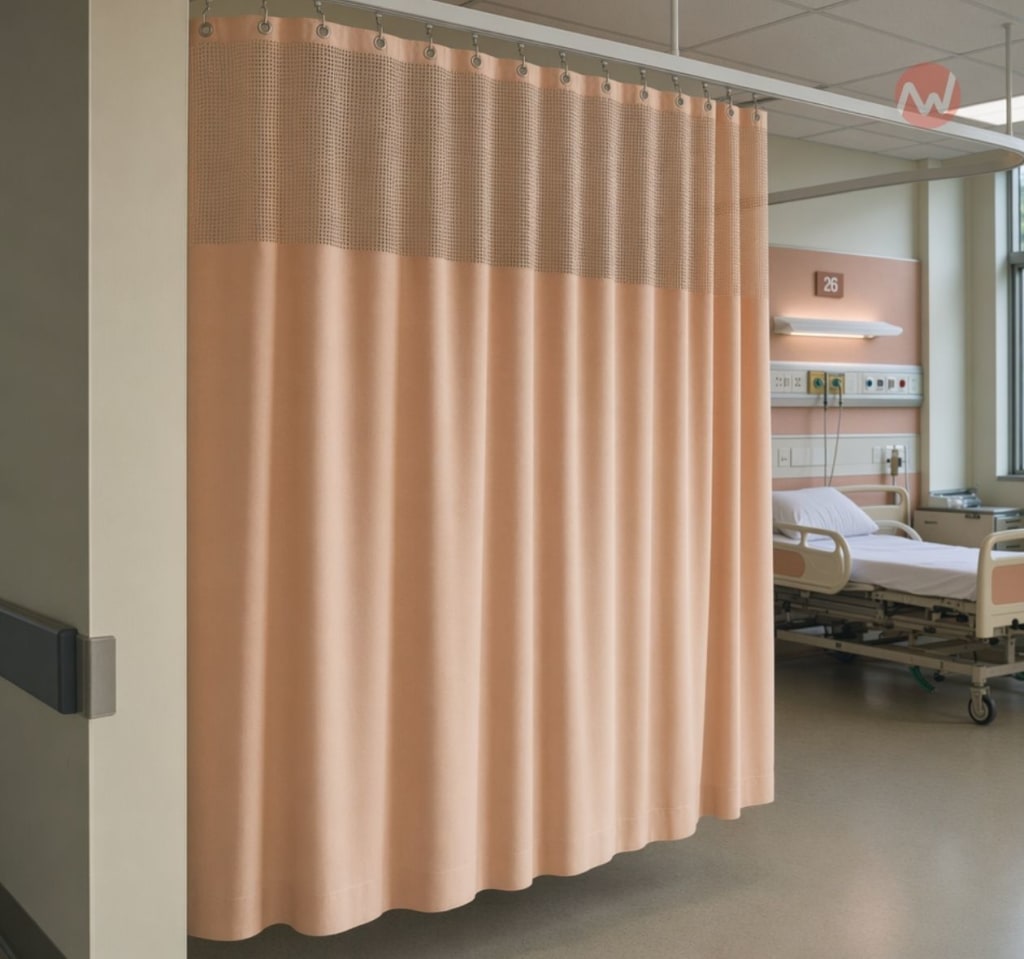
Inside the cubicle curtain.
You know the curtain hangs from the track. You may not know what changes between a 120 GSM consumer panel and a 180 to 220 GSM hospital panel. The header, the body, and the care cycle each decide whether your curtain lasts the rotation or fails the audit. Below: the three parts, what each does, and why the hospital weight band is heavier.
Header (four header types)
The header sits at the top edge of the curtain. It carries the load against the track.
You pick from four header types:
Mesh-top hookless snap-fastener. The default. Mesh lets air and sprinkler spray through.
Mesh-top hooked carrier. Use if you keep existing ward inventory.
Tear-away anti-ligature. For mental-health and at-risk wards.
Closed-top hookless. For wards without ceiling sprinklers, or with sealed airflow zones.
Header is the only operational choice on the curtain. Everything else is fabric and dimension. Specify it on your BOQ at design stage.
Body (FR antimicrobial polyester plain weave at 180-220 GSM)
The body is 100% polyester plain weave at 180 to 220 GSM. FR and antimicrobial treatments are applied at manufacture.
Standard interior polyester runs at 120 to 160 GSM. That weight tears at the header, fades at the hem, and warps under the 71°C wash. The 180 to 220 GSM band holds.
Your body ships with a stitched, weighted hem rated for 71°C wash. It also includes a two-pass overlap at the bay opening, sized to your specific privacy line.
Body fabric is the same across all three configurations. Only the header and accessories differ.
Care and cycle (wash protocol + change-cycle log)
Care and replacement are operational, not structural. But they decide whether your curtain reaches its full antimicrobial life or fails the audit first.
Wash at 71°C with chlorine-based hospital detergents at protocol working concentration. The curtain stays antimicrobial through 50+ wash cycles.
Replace on the change-cycle log, not on visual wear. The log template ships with your first ward order, so the audit-ready file is in place from day one.
Order replacement batches against the next cycle, not against the failure rate. Your procurement budget stays predictable.
Privacy that holds at the bay opening.
Patient dignity lives at the curtain line. Visitors who walk in glance through. Other patients see across at standing height. Three things hold the privacy line: the two-pass overlap at the opening, the 180 to 220 GSM fabric that absorbs the silhouette, and the custom cut to bay dimension.
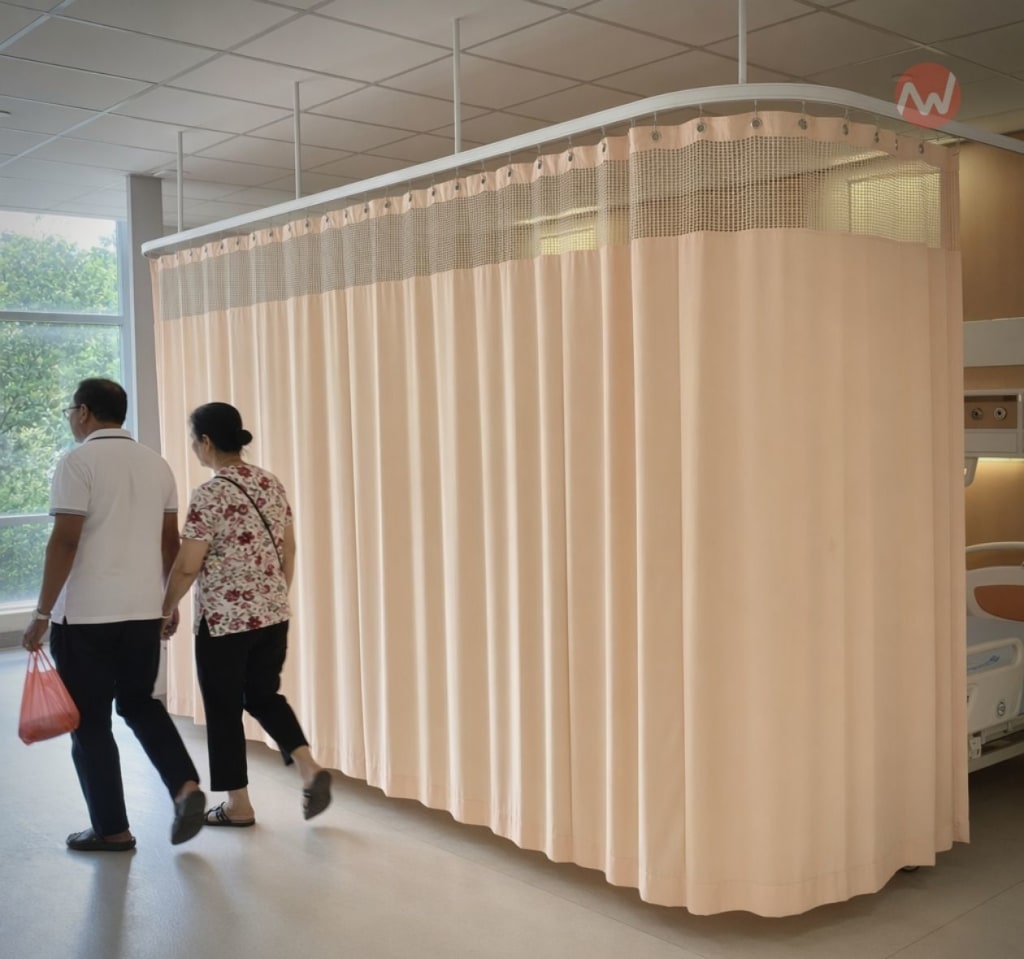
Privacy that holds at the bay opening.
Patient dignity lives at the curtain line. Visitors who walk in glance through. Other patients see across at standing height. Three things hold the privacy line: the two-pass overlap at the opening, the 180 to 220 GSM fabric that absorbs the silhouette, and the custom cut to bay dimension.
Two-pass overlap at the bay opening
A single-pass closure leaves a sightline gap at the centre of the bay opening. That is exactly where the next patient or visitor stands.
We extend the curtain with a two-pass overlap, sized to your privacy line at quote.
Standard on examination rooms, recovery bays, ICU, and any bay where the privacy fail point is the opening. The overlap is made into the curtain panel, not a clip-on accessory.
Specify it on the bays where it matters. Skip it where the bay layout doesn’t need it.
180 to 220 GSM plain weave that blocks the silhouette
Standard interior polyester runs at 120 to 160 GSM. That weight lets silhouette light through at standing distance.
Your curtain is 180 to 220 GSM in plain weave. It absorbs the silhouette at typical bay distances. It also softens the conversation that would otherwise carry across the bay opening.
The added weight keeps the curtain hanging straight when airflow shifts between bays. The privacy line you specify at install is the privacy line at quarter-end.
Most MY and SG procurement officers move to this weight band after one replacement cycle on a lighter curtain.
Custom-cut to the actual bay dimension
Off-the-shelf cubicle curtains arrive in standard widths and drops. The gaps at the floor and at the bay edge compromise the privacy line.
We cut every curtain to your bay’s actual span and drop at the time of order. The Puncak Alam facility manufactures bay-by-bay, not by stock SKU. The curtain that lands on Bay 12 fits Bay 12.
For wider bays, panels are joined cleanly without a sightline gap at the seam.
A detachable blackout liner is available for observation rooms, sleep-disrupted recovery, and procedure rooms where you need light control on top of privacy.
Change the curtain in 2 minutes, not 20.
You deserve seclusion without losing daylight. Our privacy weaves and safer materials deliver comfort and confidence. Enjoy intimate evenings and secure family time.
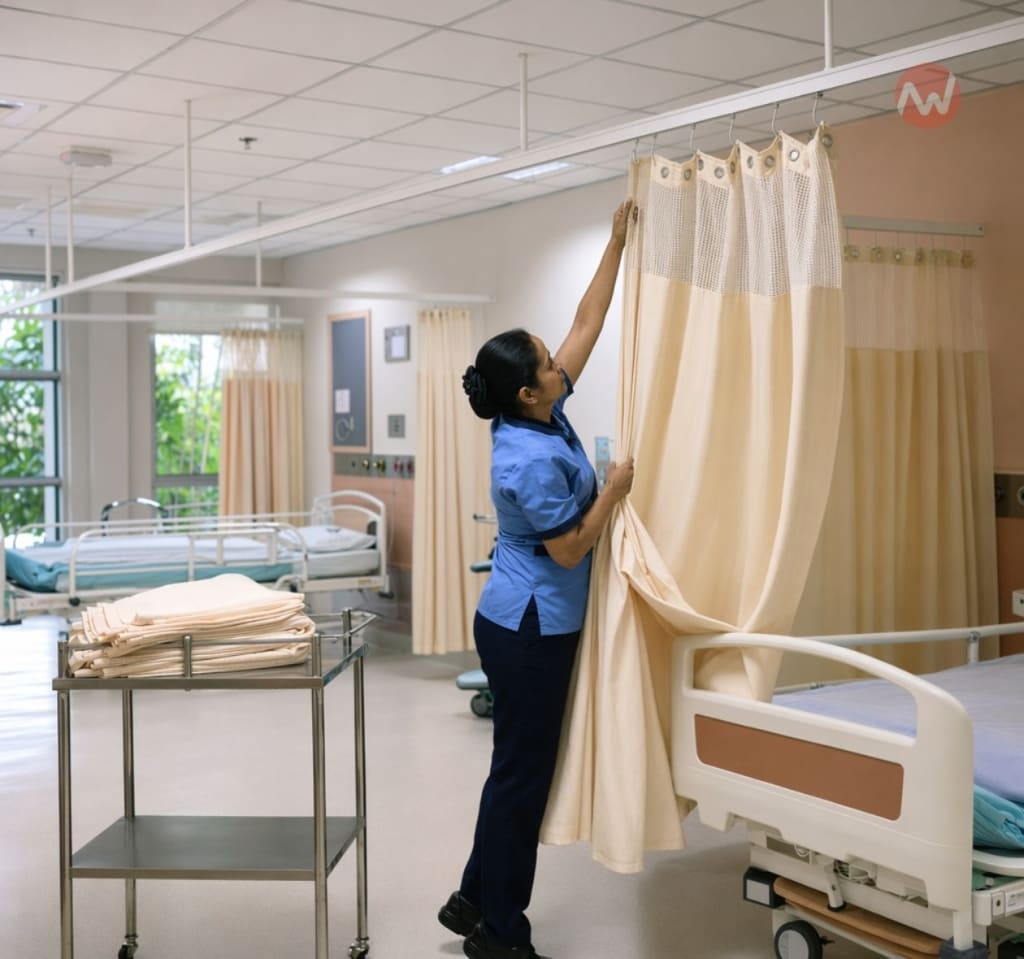
Change the curtain in 2 minutes, not 20.
You deserve seclusion without losing daylight. Our privacy weaves and safer materials deliver comfort and confidence. Enjoy intimate evenings and secure family time.
Hookless changeover from 20 minutes to 2 minutes
SafeCare BC field data records hooked-curtain changeover at 10 to 20 minutes per curtain on general-ward bays.
Your hookless header drops that to 1 to 2 minutes on the same bay. The header releases without unhooking carriers, transferring them, or rehooking each one.
Housekeeping snaps off, snaps on, walks away. From floor level. No ladder. Ladder incidents drop off the log too.
Wards moving to a tighter change-cycle protocol most often move because hookless makes the new interval feasible at current headcount.
Antimicrobial efficacy through 50+ wash cycles
A fabric that passes ISO 20743 at first wash is not the same as one that passes at the 50th wash. The auditor checks the 50th.
Your curtain stays antimicrobial through 50+ wash cycles. 99.9 percent bacterial reduction in 24 hours against MRSA, E. coli, and S. aureus.
The fabric, the stitched hem, and the header all survive 71°C wash with chlorine-based hospital detergents at protocol concentration.
At a 7 to 14 day changeover interval, you get roughly 12 to 24 months of antimicrobial-rated life per curtain.
Curtain change log template ships with the first ward order
The MSQH or JCI inspector reviews the change log, not the curtain itself.
Your first ward order ships with a change-log template. It covers the changeover date, the bay ID, the curtain serial, the housekeeping operator initials, and the cert pack reference.
You get a documented, audit-defensible artefact on day one. No waiting for the first audit visit to flag the gap and then building a template after.
The template is sized for a clipboard or a tablet entry. Format is up to your ward.
The spec that survives VE close.
At VE close, the contractor proposes a substitute. You watch your spec pass the evaluation committee. Then watch the substituted product fail BS 5867 Type C at fire inspection. Or fail the next antimicrobial audit. The fix: tender-defensible language at evaluation, the cert pack filed before delivery, and the 21-hospital reference list ready for the next bid. Below: the cert pack ship-with-order promise, the BS 5867 versus NFPA 701 decoding, and the project references you can ask for.

The spec that survives VE close.
At VE close, the contractor proposes a substitute. You watch your spec pass the evaluation committee. Then watch the substituted product fail BS 5867 Type C at fire inspection. Or fail the next antimicrobial audit. The fix: tender-defensible language at evaluation, the cert pack filed before delivery, and the 21-hospital reference list ready for the next bid. Below: the cert pack ship-with-order promise, the BS 5867 versus NFPA 701 decoding, and the project references you can ask for.
Four-cert stack ships per order, not on request
Most cubicle curtain suppliers ship certs on request. The cert pack reaches the facility manager days or weeks later.
Your four-cert stack ships with the order, filed in the documentation envelope:
– BS 5867 Part 2 Type C for fire.
– ISO 20743 for antimicrobial efficacy (not ISO 22196, which is a non-porous surface test and does not apply to curtain fabric).
– BS 6095 for the companion track.
– ISO 9001 for the Puncak Alam manufacturing facility.
You open the order on day one, file the pack once, and the audit-ready file is in place for the next MSQH visit.
In future tenders, you can require the cert pack to ship with delivery. That screens out suppliers without a current cert position.
BS 5867 Part 2 Type C, not just NFPA 701
Legacy hospital tender language often reads “fireproof NFPA 701”.
That phrase is wrong on two counts. NFPA 701 is a flame-resistance test, not a fireproof rating. And BS 5867 Part 2 Type C is the more accurate fire spec for curtains in healthcare under UK and Commonwealth practice.
Your curtain carries BS 5867 Part 2 Type C as the primary fire cert. NFPA 701 ships as a supplementary classification where imported alternatives also bid.
When you update your tender template, specify both on the same line.
21 hospital project references available on request
Every hospital tender ends on one question: where else have you delivered this.
We have delivered cubicle curtains and tracks to 21 hospital and medical cubicle projects across Malaysia and Singapore since 2008. Hospitals include Hospital Kuala Lumpur, Institut Jantung Negara, KPJ Sentul, KPJ Sentosa KL, KPJ Ampang, UM Specialist Centre, IMU, and Pantai.
Project counts and roles are available on enquiry. Named-project publication is subject to client consent.
When your tender asks for a similar-project reference list, you get an itemised file in the same business day.
Built for the wash cycle, not the spec sheet.
Spec sheets pass on paper. The wash cycle is where lower-spec fabrics fade, shrink, or lose the antimicrobial finish. The MSQH or JCI inspector checks the 50th wash, not the first. Below: the 180 to 220 GSM weight band that holds, the Grade 4 to 5 colorfastness on ISO 105, and the cycle-based replacement schedule that keeps your procurement budget predictable.
Built for the wash cycle, not the spec sheet.
Spec sheets pass on paper. The wash cycle is where lower-spec fabrics fade, shrink, or lose the antimicrobial finish. The MSQH or JCI inspector checks the 50th wash, not the first. Below: the 180 to 220 GSM weight band that holds, the Grade 4 to 5 colorfastness on ISO 105, and the cycle-based replacement schedule that keeps your procurement budget predictable.
180 to 220 GSM plain weave for hospital traffic
Standard interior polyester at 120 to 160 GSM tears at the header where patients pull. It fades at the hem where housekeeping carts catch. It warps at the body when airflow shifts between bays.
Hospital traffic is not standard interior.
Your curtain is 180 to 220 GSM plain weave. That is the weight band MY and SG procurement officers most often specify after a first replacement cycle on a lighter curtain.
Header carriers and hem are reinforced with stitched tape rated for 71°C wash. The structural anchors hold across the full antimicrobial life of the curtain.
The added weight is operational, not aesthetic. It is what keeps the curtain in service through the laundry rotation.
Colorfastness Grade 4 to 5 on ISO 105 across the rotation
Colorfastness Grade 5 on ISO 105 means no observable change after the test. Grade 4 means a slight observable change, accepted for hospital laundry under most MY and SG protocols.
Your curtain holds Grade 4 to 5 across the wash rotation. Shrinkage stays under 3 percent at 5 washes, so the bay span and overlap stay inside the spec tolerance documented at install.
A curtain on Bay 7 that has been through twenty washes looks the same as a curtain on Bay 12 that has been through five.
Visual consistency is what the audit photo records. Spec consistency is what makes it possible.
Replaceable on cycle, not on failure
Most MY and SG hospitals replace cubicle curtains reactively. Replace when the curtain fails an audit, tears at the header, or fades past the housekeeping threshold.
We design our curtains to be replaced on schedule, against your change-cycle log. You order replacement batches sized to the next cycle, not to the failure rate.
The unit economics of cycle-based replacement are predictable. Failure-based replacement is not.
When you shift from failure-based to cycle-based, you save twice. On per-curtain unit cost (planned batch versus emergency order). And on changeover labour (scheduled versus reactive).
The four certs your tender should specify.
Legacy hospital tender language often reads "fireproof NFPA 701". NFPA 701 is a flame-resistance test, not a fireproof rating. Below: the four certs that actually apply to MY and SG hospital cubicle curtains, how to write the tender line correctly, and which standards you can stop citing.

The four certs your tender should specify.
Legacy hospital tender language often reads "fireproof NFPA 701". NFPA 701 is a flame-resistance test, not a fireproof rating. Below: the four certs that actually apply to MY and SG hospital cubicle curtains, how to write the tender line correctly, and which standards you can stop citing.
BS 5867 Part 2 Type C
Fire performance for curtains in healthcare environments.
The accurate replacement for “fireproof NFPA 701” that still appears in some tender packs.
NFPA 701 is a US flame-resistance test, not a fireproof rating. Specify both BS 5867 Type C and NFPA 701 on the same line where imported alternatives also bid.
Type C is the curtain-side fire spec accepted across MY and SG private and public hospital tenders under UK and Commonwealth practice.
ISO 20743 or AATCC 100
Antimicrobial efficacy on textile.
99.9 percent bacterial reduction in 24 hours against MRSA, E. coli, and S. aureus. Durable for 50+ wash cycles.
The ISO 22196 cert some tenders cite is for non-porous surfaces. It does not apply to curtain fabric.
Update your tender language to ISO 20743 for the curtain line. Reserve ISO 22196 for track finishes and hard surfaces. AATCC 100 is the US equivalent and ships on request.
BS 6095
Hospital cubicle track manufacturing standard. The companion to the curtain spec.
We make the track to BS 6095 at the same Puncak Alam facility. The cert ships in your curtain order’s cert pack, alongside the curtain-side certs.
Documented on the Hospital Cubicle Curtain Tracks page.
ISO 9001
Facility-level quality management system. Documents the Puncak Alam plant where your curtain is cut, stitched, finished, and certed.
The published MY and SG hospital cubicle curtain spec checklist names six items. We meet all six.
Your cert pack ships with every order, not on request.
Complete technical specifications.
Cert. Pack
- BS 5867 Part 2 Type C (fire).
- ISO 20743 (antimicrobial).
- BS 6095 (companion track).
- ISO 9001 (Puncak Alam facility).
You file the cert pack once. It survives the next audit cycle.
Materials
Fabric composition
100% polyester, plain weave
Fabric weight
180 to 220 GSM
Fire performance
BS 5867 Part 2 Type C (alternatives: BS 5867 Pt 2 Type B, NFPA 701, M1, DIN 4102 B1)
Antimicrobial efficacy
99.9% reduction in 24h vs MRSA, E. coli, S. aureus, ISO 20743
Antimicrobial durability
Through 50+ wash cycles
Default header
Mesh-top hookless snap-fastener with 30% open mesh
Cert pack
BS 5867 Pt 2 Type C, ISO 20743, BS 6095, ISO 9001
Manufacturing
Puncak Alam, MY, 80,000 sq ft, ISO 9001
Sizes, Configurations, and Header
Manufactured to
Bay-specific span and drop
Maximum unjoined panel width
Confirmed at quote
Headers
Hookless snap-fastener (default), hooked, tear-away anti-ligature
Two-pass overlap
Available at bay opening
Blackout liner
Optional, detachable
Disposable line
Alternative SKU, stocked
Fire and Antimicrobial Compliance
Fire (primary)
BS 5867 Part 2 Type C
Fire (alternatives)
BS 5867 Pt 2 Type B, NFPA 701, M1, DIN 4102 B1
Antimicrobial (primary)
ISO 20743, 99.9% reduction in 24h
Antimicrobial (alternative)
AATCC 100 (on request)
Track companion cert
BS 6095
Facility cert
ISO 9001 (Puncak Alam)
Standards that do NOT apply
ISO 22196 (non-porous surface test)
BS 5867 cert number
Confirmed at quote
ISO 20743 test report number
Confirmed at quote
Routine Infection-Prevention Protocol
Hookless changeover time
1 to 2 min per curtain (SafeCare BC)
Hooked changeover time
10 to 20 min per curtain (SafeCare BC)
Header type for hookless
Snap-fastener
Ladder requirement
None for hookless changeover
Wash compatibility
Thermal disinfection at 71°C
Detergent compatibility
Chlorine-based hospital laundry detergents
Change-cycle log template
Ships with first ward order
Fabric Care and Maintenance
Wash temperature
71°C thermal disinfection
Detergent compatibility
Chlorine-based at protocol working concentration
Colorfastness
Grade 4 to 5 on ISO 105
Shrinkage
Less than 3% after 5 washes
Antimicrobial durability
Through 50+ wash cycles
Typical in-rotation life
12 to 24 months at standard changeover intervals
Replacement trigger
Change-cycle log, not visual wear
Anti-Ligature Provisions
Anti-ligature header type
Tear-away
Release behaviour
Releases curtain at sub-clinical load
Curtain-side release force
Confirmed at quote
Track-side breakaway force
6 to 8 kg per NHS Estates
Reference framework
NHS Estates anti-ligature guidance
Specification level
Bay-by-bay BOQ line
Recommended pairing
With track-side breakaway bracket
Typical applications
Mental-health, observation, day-procedure, at-risk wards
Specifications

Complete technical specifications.
The full spec sheet sits below in six question-headed sections covering materials, sizes, compliance, changeover, wash and care, and anti-ligature. Each section opens with a quick answer, names the audience it serves, and ends with a spec mini-table for at-a-glance extraction. Migrate values into your tender template directly.
What materials are New Way Hospital Cubicle Curtains made from?
Your Hospital Cubicle Curtain is 100% polyester plain weave at 180 to 220 GSM, treated for fire (BS 5867 Part 2 Type C) and antimicrobial efficacy (ISO 20743, 99.9 percent reduction in 24 hours). Pick from mesh-top hookless, hooked, and tear-away anti-ligature headers.
Hospital procurement officers and facility managers replacing legacy curtains that failed the last MSQH visit on either the fire cert or the curtain log.
Fabric body
The curtain body is 100% polyester in plain weave, manufactured at 180 to 220 GSM. The weight range is heavier than standard interior-grade polyester (typically 120 to 160 GSM) because hospital traffic, pulling load, and wash temperatures degrade lighter fabric. The polyester base accepts both the FR treatment and the antimicrobial finish without compromising hand or drape.
Header options
Four header types ship from the Puncak Alam line: mesh-top hookless snap-fastener (default), hooked carriers (where existing ward inventory must be retained), tear-away anti-ligature (mental-health and at-risk wards), and closed-top hookless (wards without ceiling sprinklers or with sealed HVAC zones). Header type is the only operational choice on the curtain; everything else is fabric and dimension.
Hem and overlap
The hem is stitched and weighted to keep the curtain hanging straight under airflow shifts between bays and traffic flow. The stitch survives thermal disinfection at 71°C. A two-pass overlap fabric extension is available for wider bay openings, sized at the time of order to the ward's privacy and visual-line requirement.
Mesh top
The 30 percent open mesh header is the published default for hospital cubicle curtains. The mesh allows HVAC airflow to circulate between bays and lets sprinkler systems reach the bay interior. Wards without ceiling sprinklers or with sealed HVAC zones can specify a closed-top header instead.
What sizes, configurations, and header options are available?
Every curtain is cut to your bay dimension at the Puncak Alam facility. Choose from mesh-top hookless or hooked headers, a two-pass overlap at the bay opening, an optional blackout liner for sleep and observation rooms, and a disposable inventory line for outbreak protocols.
Healthcare architects and M&E consultants mapping mixed ward floors where ICU, isolation, general, and recovery bays each carry different privacy and changeover requirements.
Custom-cut to bay dimension
The curtain ships cut to the bay's actual span and drop, sized at quote against the ward's privacy line. There is no off-the-shelf width restriction below the manufactured maximum at the Puncak Alam facility. Wider bays are met by panel joining where a single-panel manufactured width is exceeded.
Hookless versus hooked header
Hookless snap-fastener carriers cut changeover time to 1 to 2 minutes per curtain. Hooked carriers are available where the ward's existing carrier inventory must be retained. Both header types ship with the same fabric body and cert pack; the choice is operational, not material.
Two-pass overlap
A two-pass overlap fabric extension is available at the bay opening for privacy lines that fail under a single-pass closure. The overlap is sized to the ward's specific privacy requirement at the time of quote, common for examination rooms, recovery bays, and ICU.
Blackout liner option
A detachable blackout liner is available for observation rooms, sleep cycles, sensitive procedures, and any bay where light control matters. The liner removes from the primary curtain for routine wash.
Disposable inventory line
A disposable curtain inventory line is stocked as an alternative SKU for outbreak protocols where wash logistics break or where single-use disposal is the infection-control policy.
What fire and antimicrobial compliance do the curtains carry for MY and SG tenders?
Your Hospital Cubicle Curtain ships with the four-cert stack your tender should specify. BS 5867 Part 2 Type C for fire. ISO 20743 for antimicrobial (99.9 percent reduction in 24 hours against MRSA, E. coli, S. aureus, durable through 50+ wash cycles). BS 6095 for the companion track. ISO 9001 for the Puncak Alam facility. Cert pack ships per delivery.
Procurement officers and QSs filtering hospital tender bids by tender-defensible compliance language, rather than by the legacy "fireproof NFPA 701" phrasing some tender packs still carry.
BS 5867 Part 2 Type C
The accurate fire-performance standard for curtains in healthcare environments under UK and Commonwealth practice. The cert covers flame spread, ignition resistance, and after-burn behaviour for the polyester fabric body.
NFPA 701 supplementary cert
NFPA 701 is the US flame-resistance test. Legacy MY and SG tenders often label it "fireproof NFPA 701," which is inaccurate. NFPA 701 is flame-resistance, not fireproof. Your curtain carries an NFPA 701 cert as a supplementary classification. Specify both BS 5867 Type C and NFPA 701 where imported alternatives also bid.
ISO 20743 antimicrobial verification
ISO 20743 is the standard antimicrobial efficacy test for textiles. The curtain passes at 99.9 percent bacterial reduction in 24 hours against MRSA, E. coli, and S. aureus, durable through 50+ wash cycles. Efficacy at first wash is not the same as efficacy at the 50th wash; the audit checks the latter.
The ISO 22196 confusion
ISO 22196 appears in some MY and SG hospital tenders as the antimicrobial standard. ISO 22196 is the test for non-porous surfaces and does not apply to curtain fabric. Update tender language to ISO 20743 for the curtain line.
Cert pack at delivery
Every order ships with the four-cert stack filed and ready. NFPA 701 and AATCC 100 ship on request as supplementary documents.
How fast can curtains be changed for routine infection-prevention protocols?
Your hookless curtain changes over in 1 to 2 minutes per bay. Hooked systems take 10 to 20 minutes (SafeCare BC field data). Same fabric body, same cert pack. The hookless header is what cuts the cycle.
Infection-prevention nurses and housekeeping leads whose change-cycle log shows variance the auditor flags.
Hookless snap-fastener system
The header carries snap fasteners along its top edge rather than hooked carriers running on a track race. Housekeeping releases the snaps, lifts the curtain off, snaps the replacement curtain into the same positions, and walks away. The carrier set on the track remains in place; only the curtain panel is replaced.
Hooked carrier comparison
Hooked systems require the housekeeping team to unhook each carrier individually, transfer the carriers to the replacement curtain, and rehook each one onto the track race. SafeCare BC field data records this at 10 to 20 minutes per curtain.
Ladder-free changeover
The hookless snap-fastener system can be released from floor level at standard reach. The release does not require a ladder, reducing the ladder-safety incidents the segment dossier names as a separate pain point.
Thermal disinfection compatibility
The curtain fabric is compatible with thermal disinfection at 71°C in the laundry cycle. Wards running on-site thermal disinfection protocols can wash and re-snap the same curtain back into the rotation.
Curtain change log template
Every ward's first order ships with a change log template covering the changeover date, the bay ID, the curtain serial, the housekeeping operator initials, and the cert pack reference. The template is the audit artefact the MSQH or JCI inspector reviews.
How are the curtains washed, cared for, and replaced?
Your curtain washes at 71°C for thermal disinfection. It tolerates chlorine-based hospital detergents at protocol working concentration. Colorfastness holds at Grade 4 to 5 on ISO 105. Shrinkage stays under 3 percent at 5 washes.
Hospital housekeeping leads and facility teams running on-site laundry against documented MOH Malaysia and MOH-SG wash protocols.
Thermal disinfection at 71°C
The fabric body, stitched hem, and header are rated for wash at 71°C, which is the thermal disinfection threshold most MY and SG hospital laundry protocols specify. The fabric retains hand, drape, and visual appearance through the 71°C cycle.
Chlorine-based detergent compatibility
The fabric tolerates chlorine-based hospital laundry detergents at the working concentration documented in standard MY and SG protocols. Higher-concentration bleaching cycles outside the protocol can erode the antimicrobial finish; stay within the documented protocol concentration.
Colorfastness to ISO 105
Colorfastness holds at Grade 4 to 5 on the ISO 105 scale (where 5 is no observable change). This is the cross-cycle visual consistency the housekeeping audit looks for.
Shrinkage after 5 washes
The fabric measures less than 3 percent shrinkage after 5 washes. Bay span and overlap remain inside the spec tolerance for the first three months of routine wash rotations.
Antimicrobial durability through 50+ wash cycles
The ISO 20743 efficacy holds through 50+ wash cycles. At a typical ward changeover interval of every 7 to 14 days, that translates to roughly 12 to 24 months of antimicrobial-rated life per curtain in routine rotation.
Replacement by change-cycle log
Curtain replacement is scheduled against the change-cycle log, not triggered by visible wear. The ward records first deployment, wash count, and audit cycle. Procurement orders replacement batches sized to the next cycle, not to the failure rate.
What anti-ligature provisions are available for mental-health and at-risk wards?
Your curtain can ship with a tear-away anti-ligature header for mental-health, observation, and at-risk wards. The header releases at sub-clinical load (per NHS Estates). Pair it with the breakaway-bracket on the companion Hospital Cubicle Curtain Track (6 to 8 kg release per NHS Estates). Both release together.
Healthcare architects and biomedical engineers specifying mental-health, observation, day-procedure, and at-risk wards under NHS Estates anti-ligature guidance.
Tear-away header mechanism
The header along the top of the curtain replaces the standard mesh-top snap-fastener system with a tear-away configuration. Under applied load, the header releases the curtain from the carriers, dropping the curtain to the floor and removing the ligature point. The curtain itself is reusable after release; the header is replaceable as a serviceable part.
Sub-clinical release load
The header releases at a sub-clinical load (defined under NHS Estates guidance). The specific release force in kg for the curtain-side header is recorded against the spec sheet on the order, and pairs with the breakaway-bracket force on the track to give one combined release point per bay.
NHS Estates reference
The anti-ligature design follows NHS Estates guidance on cubicle and privacy curtains in mental-health, observation, and at-risk ward environments. The guidance is the most-cited reference framework in MY and SG private-hospital mental-health specs.
Pairing with the track-side breakaway bracket
The companion Hospital Cubicle Curtain Track carries a breakaway-bracket option that releases the entire track section under applied load, with NHS Estates referencing a 6 to 8 kg release threshold. Specify the tear-away header together with the breakaway bracket on the same bay so both release together.
Specification context
The tear-away header is specified bay-by-bay on the BOQ rather than as a ward-wide default. Wards mixing general bays with at-risk bays carry both header types.
Why Choose New Way
21 hospital projects across MY and SG.
Every hospital tender ends on the same question: where else have you delivered this. We have delivered cubicle curtains and tracks to 21 MY and SG hospital and medical projects since 2008. Below: the named hospitals (subject to client consent for publication), the sectors covered, and how your reference list arrives on enquiry. Public sector includes Hospital Kuala Lumpur (HKL), Institut Jantung Negara (IJN), UM Specialist Centre, and International Medical University (IMU). Private sector includes KPJ Healthcare Group (Sentul, Sentosa KL, Ampang), and the Pantai Hospital Group. Cubicle curtains, cubicle tracks, and patient-room shading were specified together on most of these projects. Full reference list with project counts and roles available on enquiry.
Beyond hospitals: clinics, mosques, aged care.
The same fabric spec ships into more than hospital wards. Dialysis clinics, TCM treatment rooms, dental practices, mosque ablution screens, surau prayer dividers, and aged-care nursing homes all specify the same curtain on smaller BOQs. Below: the verticals, the spec consistency, and how quote scaling reflects your bay count. Same fabric body: FR antimicrobial 100% polyester at 180 to 220 GSM, BS 5867 Part 2 Type C, ISO 20743. Same hookless header where the change cycle matters. Same cert pack at delivery. Different bay sizes. Different aesthetic options to match the room. Quote scaling reflects your bay count, not the protocol.
Components and accessories on the BOQ.
Procurement and dealers price the same components schedule, line by line. Below: the curtain panel, the four header types, the hem, the overlap, the certs, the change-cycle log template, and the disposable inventory line. - FR antimicrobial curtain panel. 180-220 GSM, plain weave, BS 5867 Part 2 Type C, ISO 20743. Cut to bay dimension. - Mesh-top header (30% open). Default for hospital wards; maintains HVAC airflow and sprinkler reach. - Hookless snap-fastener header (alternative). Specified where the change cycle drives the line-item decision. - Hooked header (alternative). Specified where the existing carrier inventory is retained. - Tear-away anti-ligature header (alternative). For mental-health and at-risk wards; releases at sub-clinical load. - Weighted hem. Stitched, replaceable. - Two-pass overlap fabric extension. For wider bay openings. - BS 5867 Part 2 Type C cert. Per delivery. - ISO 20743 cert. Per delivery. - Curtain change log template. Per ward, on first order. - Disposable curtain inventory line. Stocked alternative for outbreak-protocol pivots.
Authorized Fabricator for Renson, Aqara, Lutron
New Way is the licensed Renson Fixscreen fabricator and installer for Malaysia and Singapore. We have also been a Lutron-approved fabricator since 2022, and we are an Aqara partner.


Trust, Reach & Recognition
New Way Group, founded 1993; full pivot to intelligent shading in 2018; Singapore entity since 2025.
Licensed Renson Fixscreen fabricator and installer for Malaysia and Singapore. Lutron-approved fabricator since 2022.
316 marine-grade stainless hardware throughout, 10+ year operating life, 3-year system and 5-year motor warranty.
Frequently Asked Questions
Pre-Sales
What's the difference between hospital cubicle curtains and hospital cubicle curtain tracks, and do we need to specify both?
Hospital cubicle curtains and hospital cubicle curtain tracks are companion products normally specified together on the same hospital BOQ. The curtain is the FR antimicrobial 100% polyester fabric panel (180 to 220 GSM) that hangs at the bay. The track is the aluminium profile and bracket system the curtain hangs from. New Way manufactures both at the 80,000 sq ft Puncak Alam facility under ISO 9001, and the four-cert stack covers them as a system: BS 5867 Part 2 Type C on the curtain, BS 6095 on the track, ISO 20743 for the antimicrobial finish, and ISO 9001 for the manufacturing facility. Specify both lines on the tender to maintain cert and warranty continuity across the bay.
How do New Way hospital cubicle curtains compare to imported alternatives?
New Way hospital cubicle curtains meet the published MY and SG hospital cubicle curtain spec checklist: BS 5867 Part 2 Type B or equivalent fire performance, ISO 20743 antimicrobial efficacy, chlorine-detergent cleanability, cordless or motorised in patient areas, adjustable light filtering to blackout, and 5-year warranty minimum. The structural difference is local manufacture: the 80,000 sq ft Puncak Alam facility ships the cert pack with the order and supports the MY and SG market with one-hop audit traceability rather than imported supply chain layers. 21 hospital and medical cubicle projects delivered since 2008.
Why would we switch suppliers for cubicle curtains if we already have an indoor shading supplier?
Hospital cubicle curtains and patient-room shading are increasingly procured from a single supplier in MY and SG private-sector hospital projects (Healthcare Specifier segment dossier, 2026). New Way’s six-product capability (cubicle curtains, cubicle tracks, in-house roller shades, Lutron motorised drapery, Renson Fixscreen outdoor, and Roman or honeycomb where specified) lets one supplier carry the bay, the patient room, the VIP suite, and the rooftop terrace under one warranty stack and one site manager. Procurement teams running multi-format hospital projects most often save coordination overhead through consolidation rather than format-by-format sourcing.
Can we specify New Way hospital cubicle curtains for non-hospital clinical settings like clinics, TCM, surau, mosques, or aged-care nursing homes?
Yes. New Way hospital cubicle curtains specify identically into dialysis clinics, TCM treatment rooms, surau prayer dividers, mosque ablution screens, dental clinics, physiotherapy practices, outpatient day-surgery centres, and aged-care nursing homes. The fabric spec (FR antimicrobial 100% polyester, 180 to 220 GSM, BS 5867 Part 2 Type C, ISO 20743), the cert pack, and the hookless changeover system carry across the verticals unchanged. Quote scaling reflects the bay count, not the protocol; smaller-bay-count BOQs ship from the same Puncak Alam line as hospital orders.
Can New Way hospital cubicle curtains retrofit onto existing hospital tracks from a different supplier?
Yes. New Way hospital cubicle curtains retrofit onto most existing hospital cubicle track systems where the header carrier spacing and snap-fastener compatibility match. Fit is confirmed at quote stage by checking the existing track profile, carrier spacing, and bracket dimensions against the curtain header specification. For wards retrofitting in stages, the curtain ships first against the existing track infrastructure; the companion BS 6095 New Way track upgrade can follow on a separate capex cycle without forcing both lines onto the same order. Specifiers can phase the BOQ.
Specifications
What is the maximum bay width a single panel can cover before joining is required?
New Way hospital cubicle curtains manufacture to bay dimension at the Puncak Alam facility, with the single-panel maximum width confirmed at quote stage against the bay span on the ward layout. Wider bays beyond the single-panel ceiling are met by panel joining without a sightline gap at the seam. For typical MY and SG hospital ward layouts (examination bays, ICU bays, recovery bays, isolation rooms), single-panel manufacture covers the standard configurations; joining is most often used on multi-bay continuous runs or non-standard ward geometries documented at survey. The current single-panel maximum is shared on enquiry.
Materials
What fabric weight and weave is used for hospital cubicle curtains?
New Way hospital cubicle curtains are manufactured in 100% polyester plain weave at 180 to 220 GSM, which is the weight band most MY and SG hospital procurement officers specify after the first replacement cycle on lighter-weight curtains. Standard interior polyester at 120 to 160 GSM tears at the header, fades at the hem under cart traffic, and warps under airflow shifts between bays. The 180 to 220 GSM band sits above standard interior weight, accepts the FR antimicrobial finish without compromising hand or drape, and holds the silhouette at standing distance for bay privacy.
Are New Way hospital cubicle curtains PVC-free?
New Way hospital cubicle curtains are PVC-free in the standard fabric body and the standard header configurations. The fabric is 100% polyester plain weave with FR antimicrobial finish, neither of which uses PVC. Hospital procurement teams updating tender language to exclude PVC for environmental, recyclability, or off-gassing reasons can specify on the curtain line item without forcing a fabric substitution. The disposable inventory line and the optional blackout liner ship in different material compositions; confirm at quote stage for projects requiring strict PVC-free compliance across the full BOQ.
Performance
How does the antimicrobial performance hold up across wash cycles?
New Way hospital cubicle curtains hold ISO 20743 antimicrobial efficacy at 99.9 percent bacterial reduction in 24 hours against MRSA, E. coli, and S. aureus, durable through 50+ wash cycles. The MSQH or JCI auditor checks efficacy at the 50th wash, not the first wash, so wash-cycle durability is what determines audit compliance. At a typical ward changeover interval of every 7 to 14 days, that translates to roughly 12 to 24 months of antimicrobial-rated life per curtain in routine rotation. Replace by the change-cycle log, not by visible wear.
How long does a hospital cubicle curtain last in routine ward rotation?
New Way hospital cubicle curtains hold their antimicrobial-rated life through 50+ wash cycles, which equals roughly 12 to 24 months of routine rotation at a typical 7 to 14 day ward changeover interval. The fabric body holds colorfastness Grade 4 to 5 on ISO 105 across the rotation and shows less than 3 percent shrinkage after 5 washes, so visual and dimensional consistency hold inside the same window. Replace on the change-cycle log against the antimicrobial threshold rather than against visual wear; this keeps procurement batches predictable and emergency replacement orders rare.
Safety
Our tender pack still says 'fireproof NFPA 701'. Is that the right spec line?
The phrase “fireproof NFPA 701” is incorrect on two counts: NFPA 701 is a US flame-resistance test, not a fireproof rating, and BS 5867 Part 2 Type C is the more accurate fire spec for curtains in MY and SG healthcare environments under UK and Commonwealth practice. New Way hospital cubicle curtains carry BS 5867 Part 2 Type C as the primary cert and NFPA 701 as supplementary documentation where imported alternatives also bid. Update the tender template to specify BS 5867 Part 2 Type C; keep NFPA 701 as an “or equivalent” reference for mixed-bidder fields.
What anti-ligature provisions are available for mental-health and at-risk wards?
New Way hospital cubicle curtains offer a tear-away anti-ligature header for mental-health, observation, and at-risk wards. The header releases the curtain from the carriers at sub-clinical load (per NHS Estates guidance), dropping the curtain to the floor and removing the ligature point. Pair with the companion Hospital Cubicle Curtain Track breakaway-bracket option, which releases at 6 to 8 kg per the same NHS Estates framework, on the same bay so both release together. The tear-away header is specified bay-by-bay on the BOQ, so mixed wards can carry standard and at-risk configurations side by side.
Is the curtain fire-rated for general hospital ward use under MOH Malaysia and MOH Singapore guidance?
New Way hospital cubicle curtains carry BS 5867 Part 2 Type C as the primary fire performance cert, which is the standard MY and SG hospital tenders should specify under UK and Commonwealth practice. The curtain additionally carries NFPA 701 (US), M1 (French), DIN 4102 B1 (German), and BS 5867 Part 2 Type B classifications as supplementary documentation. MOH Malaysia and MOH Singapore do not publish a single mandated curtain fire spec at federal level; hospital procurement teams set the spec per facility, and the BS 5867 Part 2 Type C cert ships per delivery in the cert pack.
Warranty
What does the warranty cover, what is the term, and how fast can emergency replacements ship?
New Way hospital cubicle curtain warranty terms are issued in writing per quote against the project scope, the wash protocol, and the changeover interval the ward operates on. The MY and SG hospital cubicle curtain market benchmark is a 5-year minimum on manufacturing defects; New Way’s specific terms accompany the cert pack at delivery. For emergency replacements (audit-triggered swaps, mid-cycle curtain failure), the in-house Puncak Alam line supports priority orders; replacement lead time is confirmed at quote against the project’s stock-and-rotation plan.
Buying Journey
How do we request the cert pack, project reference list, and a quote for a hospital cubicle curtain project? Can our architect or M&E consultant engage New Way directly during design stage?
Hospital cubicle curtain enquiries can be opened by procurement, the facility team, the M&E consultant, the healthcare architect, or the appointed dealer. Early architect and M&E consultant engagement during the design stage is preferred for project-grade hospital build-outs: spec language, cert references, BIM and CAD assets, and the 21-hospital project reference list arrive faster when the spec is being written rather than after VE close. Quote, cert pack, project reference list, and component schedule typically arrive within the same business day as the enquiry. Routes: sales@newwaykl.com, the website enquiry form, or the WhatsApp chat line.
Ready to grow your business with premium roller blinds trusted by Lutron, Aqara & Renson?
Join our dealer network and offer world-class shading solutions backed by authorized fabricators and global support
Get Pricing & Catalog
Sales will call in 1 business day and arrange physical catalog.
Chat via WhatsApp
Chat with our dealer team
for pricing and availability.
Mon–Sat, 8am – 5pm.
Contact Us Directly
We reply within 1 business day.
Support Hours: Mon–Fri 9:00–18:00, Sat 10:00–14:00 (MYT)


